This Article Contains
Why Your Mirror Face and Photo Face Look Different
There are three differences between your mirror face and your photo face: left-right reversal, the influence of lens and distance, and shooting angle.
A mirror reverses left and right. The "your face" you see every day is actually the opposite of what others see. Because photos capture the angle other people see, you get the sensation of "is that really what I look like?" This discomfort is not because your face has changed — it's because you're seeing it from an unfamiliar direction.
The focal length of the lens and the shooting distance also affect how your facial features appear. A wide-angle lens at close range emphasizes your nose and cheeks, while a medium telephoto lens at a greater distance produces a more balanced facial proportion (see FIG.081). Because the distance and angle of your mirror differ from your shooting conditions, the same face ends up looking different.
How Familiarity with Your Mirror Face Creates Discomfort
People feel comfortable with what they see every day. Because you've stored the mirror image as your "correct face," anything that differs from it triggers an immediate sense of wrongness.
This phenomenon isn't unique to photos. The reason your recorded voice sounds "different" to you follows the same principle. The voice you're used to hearing through bone conduction and the voice captured by a microphone via air vibration are produced under different conditions — just like the mirror and a photo.
The stronger your attachment to your familiar mirror face, the stronger your resistance to your photo face. Yet what others recognize as "you" is the face shown in photos. The mirror version is actually a face other people have never seen.
FIG. 112A diagram organizing the three reasons your face looks different in photos versus the mirror: left-right reversal, lens, and angle.
How Distance and Lens Change the Impression
Smartphone selfies use the equivalent of a 24–28mm wide-angle lens, with only an arm's length of distance available. Under these conditions, the nose and cheeks tend to look larger, which can be very different from what you see in the mirror.
The same face can look quite different when taken from a slightly greater distance. Even moving your smartphone 30–50 cm farther away reduces the perspective exaggeration of close-range shots. Propping the phone on a shelf or wall and using a timer makes an even bigger difference.
If photos taken professionally with an 85–135mm lens at a greater distance seem to make you "look better than usual," it's because your facial proportions are being captured closer to reality. This is a difference in shooting conditions — not the photographer's "magic."
Don't Mistake Unfamiliarity for a Flaw
Problems arise when you immediately label the discomfort you feel looking at a photo as a "flaw." The impression that "my nose stands out" or "my face looks big" may come entirely from shooting conditions (close distance, wide angle), yet it gets stored in memory as a facial problem.
When you feel discomfort, the first thing to check is the shooting conditions. Whether it was a close-range smartphone selfie or a medium-telephoto shot makes a significant difference to the result. Compare with another photo taken under different conditions and see whether the same discomfort appears.
Heavy retouching to bring a photo closer to your mirror face is also worth avoiding for the same reason. Even if it looks more like the mirror, if it no longer looks like you in person, it stops functioning as a profile photo (see FIG.063).
The difference between your mirror face and your photo face can be understood as a difference in viewing conditions, not a change in your face.
How to Evaluate Photos When Choosing One
When selecting from candidate photos, it's important not to use similarity to your mirror face as the standard. Instead, ask whether the photo contradicts how you look when meeting someone in person. If someone who sees your photo recognizes you immediately when you meet, it's working as a profile photo.
It's also important not to delete photos based solely on your first impression. Even a photo that felt off at first glance may look different after a little time has passed. First-impression discomfort often stems from unfamiliarity, so set the photo aside and look again later.
For the final photo you keep, it's worth trying a horizontal flip. Mirroring it in a smartphone app puts it in the same orientation as your mirror image. Comparing the flipped and original versions to see which feels less unfamiliar can be a useful reference.
- The three reasons your mirror face and photo face look different are left-right reversal, lens distance, and shooting angle. Your face has not changed.
- Your attachment to the familiar mirror face creates discomfort with photos. Others see you in the photo orientation, not the mirror orientation.
- When choosing a photo, use "does this contradict how I look in person?" as your standard rather than "does this look like my mirror face?"
Related Diagrams
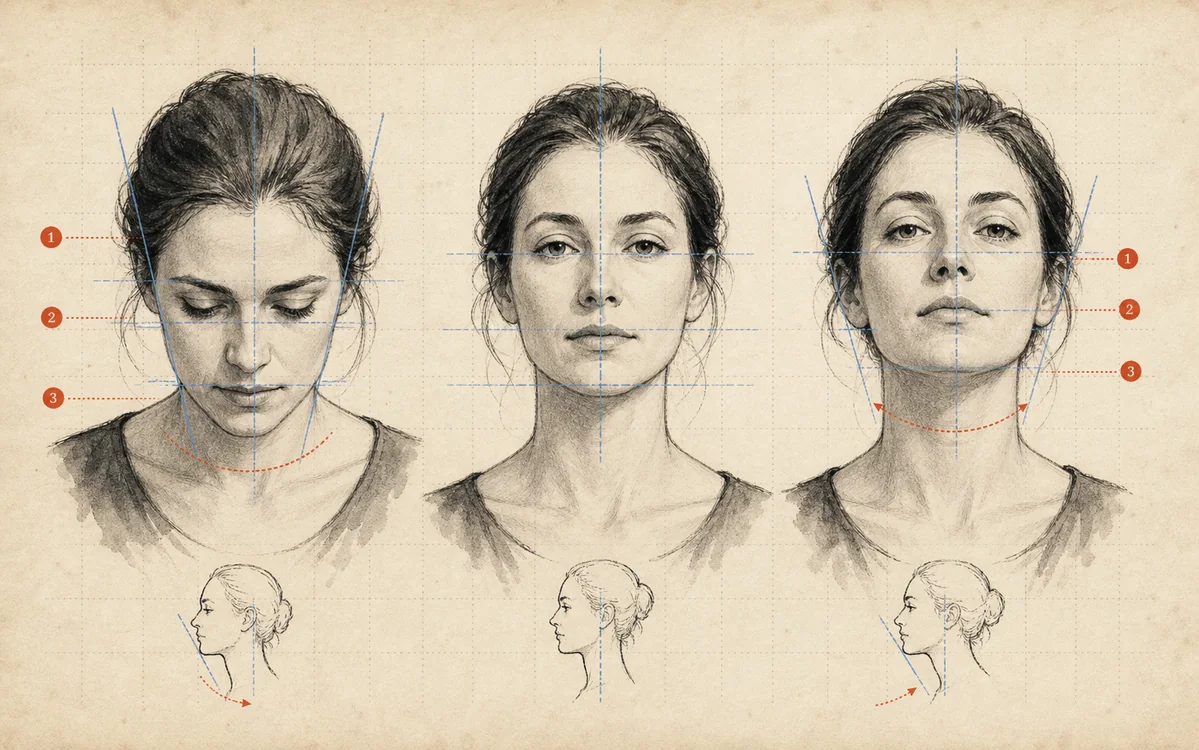 FIG.003Pull Your Chin Back 1 cm and Your Jawline Looks Slimmer in PhotosWithout dropping your neck, keep the back of your head lifted and draw only your chin tip back — this helps define both the jawline and the neck area.
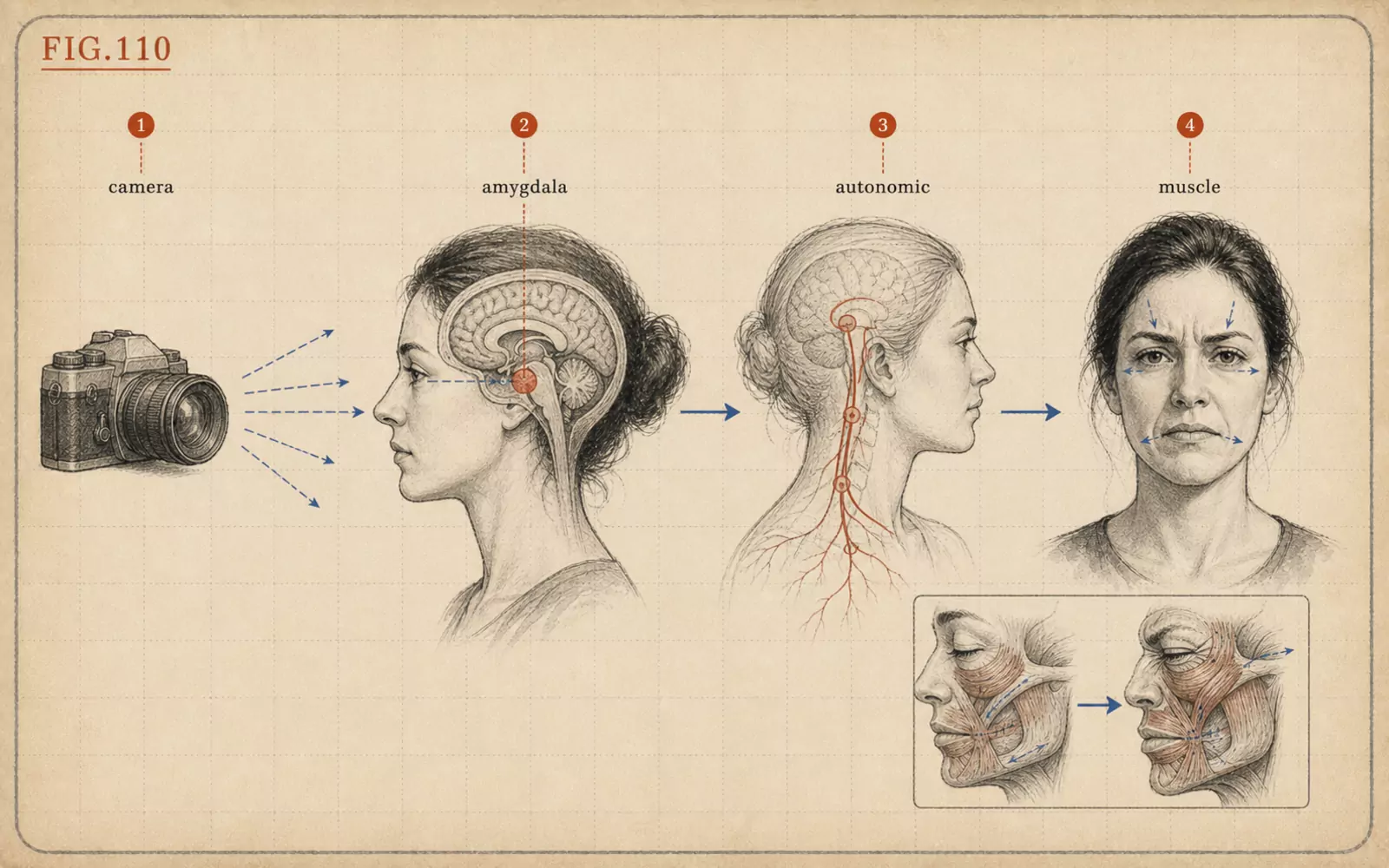 FIG.110The Truth About Camera Anxiety: Why Your Body Freezes When a Camera Is Pointed at YouFreezing in front of a camera is not a failure — it's your body's defensive response. Addressing breath, shoulders, and gaze separately makes it manageable.
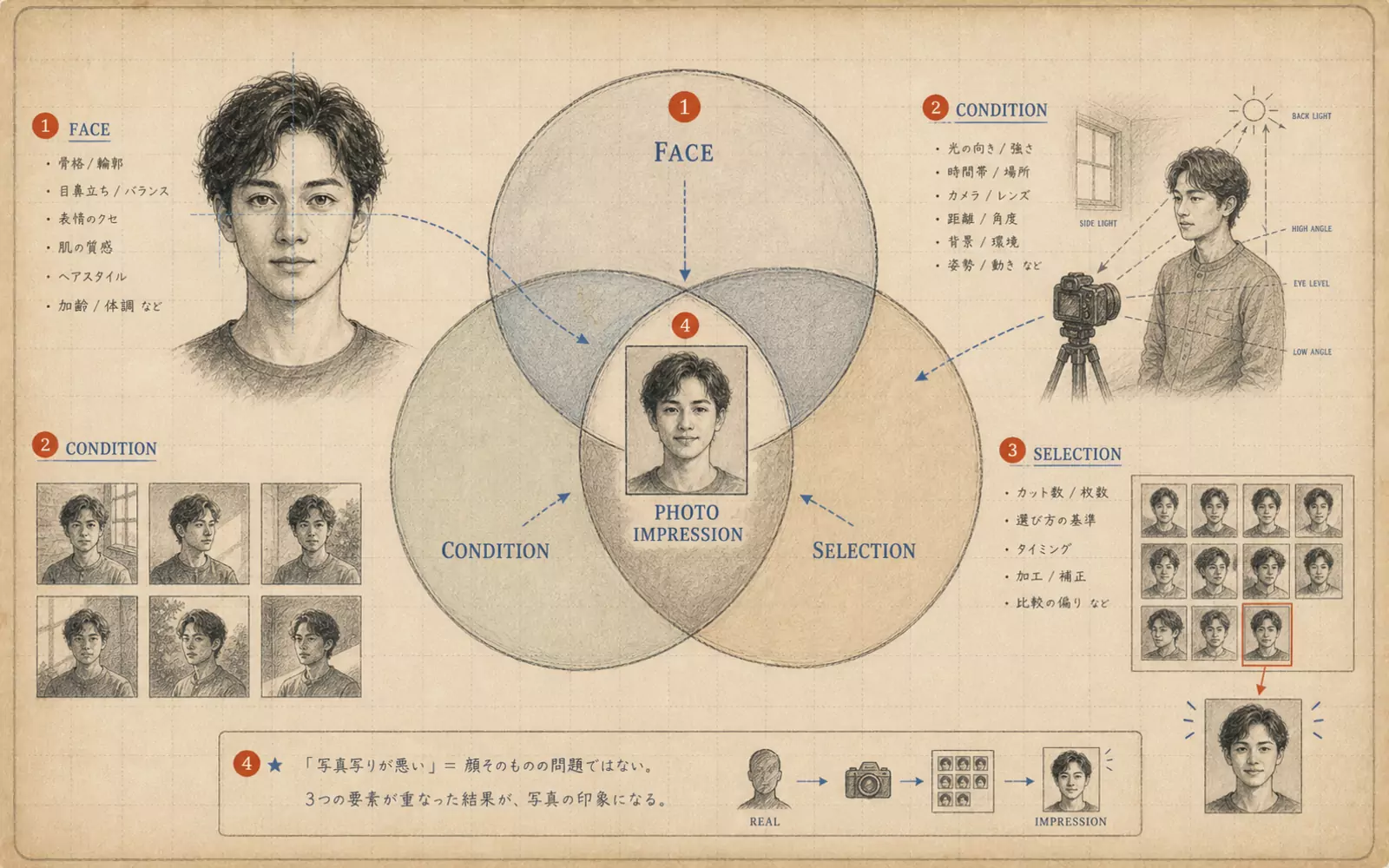 FIG.115Is "Photogenic" Really Real? Separating Beliefs from Objective FactsThe worry about not being photogenic can be broken down into your face, shooting conditions, and photo selection. Don't blame only your face.