This Article Contains
Bust-Up and Full-Body Shots Have Different Roles
When shooting audition photos, trying to get a single shot where both the bust-up and full-body "look great" tends to make both feel incomplete. These two shots show different things from the start.
A bust-up shot shows your expression, the light in your eyes, the length of your neck, the relaxation of your shoulders, and your overall cleanliness. Its purpose is to convey the impression of your face accurately. A full-body shot shows how you stand, the stability of your center of gravity, the position of your arms, the silhouette of your clothing, and your overall body proportions. Rather than shooting from a close angle, it is important to create a state where your body lines look well-composed from a slightly pulled-back distance.
Understanding the difference in roles beforehand simplifies your instructions before the shoot and speeds up your decision-making on the day.
What Judges Look For in a Short Amount of Time
Judges look at expression, cleanliness, body lines, posture, and how clothing appears — all in a short amount of time. Trying to pack all of that information into a single photo makes each element harder to read.
Even if only the face looks great, a photo where body proportions and posture are difficult to read lacks the information needed for evaluation. Conversely, a photo where posture is perfect but the facial expression is flat is easy to eliminate on first impression.
By dividing the roles between bust-up and full-body shots, each photo can reliably communicate one piece of information.
FIG. 130An educational diagram for understanding how to divide the roles of bust-up and full-body shots in audition photos.
Dividing What You Show Between Bust-Up and Full-Body
For bust-up shots, check the light in your eyes, the set of your mouth, the length of your neck, and the tension in your shoulders. Decide whether to look directly at the lens or to gaze slightly off to one side. A mouth that is slightly open with your front teeth barely visible conveys a natural and energetic impression.
For full-body shots, check how you stand, your center of gravity, the position of your arms, and the silhouette of your clothing. Requesting these separately before the shoot as "one shot where the expression is clear" and "one shot where the proportions are clear" will reduce hesitation on the day. A short message to the photographer — "Please shoot the full-body at a distance that minimizes distortion" — is sufficient.
A shot cropped at the knee is also very useful. As a cut between bust-up and full-body, you can read your stance and the full look of your clothing. Even if you have no specific submission requirement, keeping three patterns — bust-up, knee-up, and full-body — makes the selection process easier.
What Happens When a Full-Body Shot Is Taken Too Close
Trying to shoot a full-body at the same close distance as a bust-up causes the feet and hands in the foreground to appear larger, deviating from your actual body proportions. The closer the camera, the stronger the perspective distortion (see FIG.081), and this is especially visible in poses where the hands or feet extend forward, making them appear larger than they actually are.
A common mistake is to use the same angle as the bust-up directly for the full-body. Shots where the facial impression looks good are often taken at a short distance, and applying that same distance to a full-body shot tends to make only the legs and hands stand out.
Focusing too hard on making an expression can also cause the feet and shoulder direction to fall apart. When shooting full-body, rather than trying to correct the face, body, and clothing all at once, first confirm your center of gravity and shoulder height, then move on to expression (see FIG.028).
For audition photos, prepare separately — one for expression and one for checking proportions.
Checks Before, During, and After the Shoot
Before the shoot, confirm the number of photos, aspect ratio, and whether a full-body shot is required for your submission. Even if there are no specifications, shooting the bust-up, knee-up, and full-body separately makes selection easier. If the photos will be used on social media, keep a square-croppable margin in mind; for print, be aware of a portrait-oriented composition with vertical margin.
During the shoot, check the full-body cuts on the monitor all the way down to the feet. Look for whether the width of your head, shoulders, waist, and feet appears significantly different from your actual proportions. Shooting from a slightly pulled-back position with a standard to medium telephoto lens will make your body proportions look natural.
When selecting photos, do not decide based solely on the shot where you like your face best — keep the ones that contain the information your submission recipient wants to see. Prioritize photos where posture and proportions are readable even when the image is displayed small. Submit a combination that communicates both your facial impression and your body's impression.
- Shoot bust-up and full-body shots separately, assigning the bust-up the role of showing expression and the full-body the role of showing posture and body proportions.
- For full-body shots, body proportions will distort if the camera is too close. Keeping a proper distance is essential.
- Requesting the roles separately before the shoot speeds up decision-making on the day.
Related Diagrams
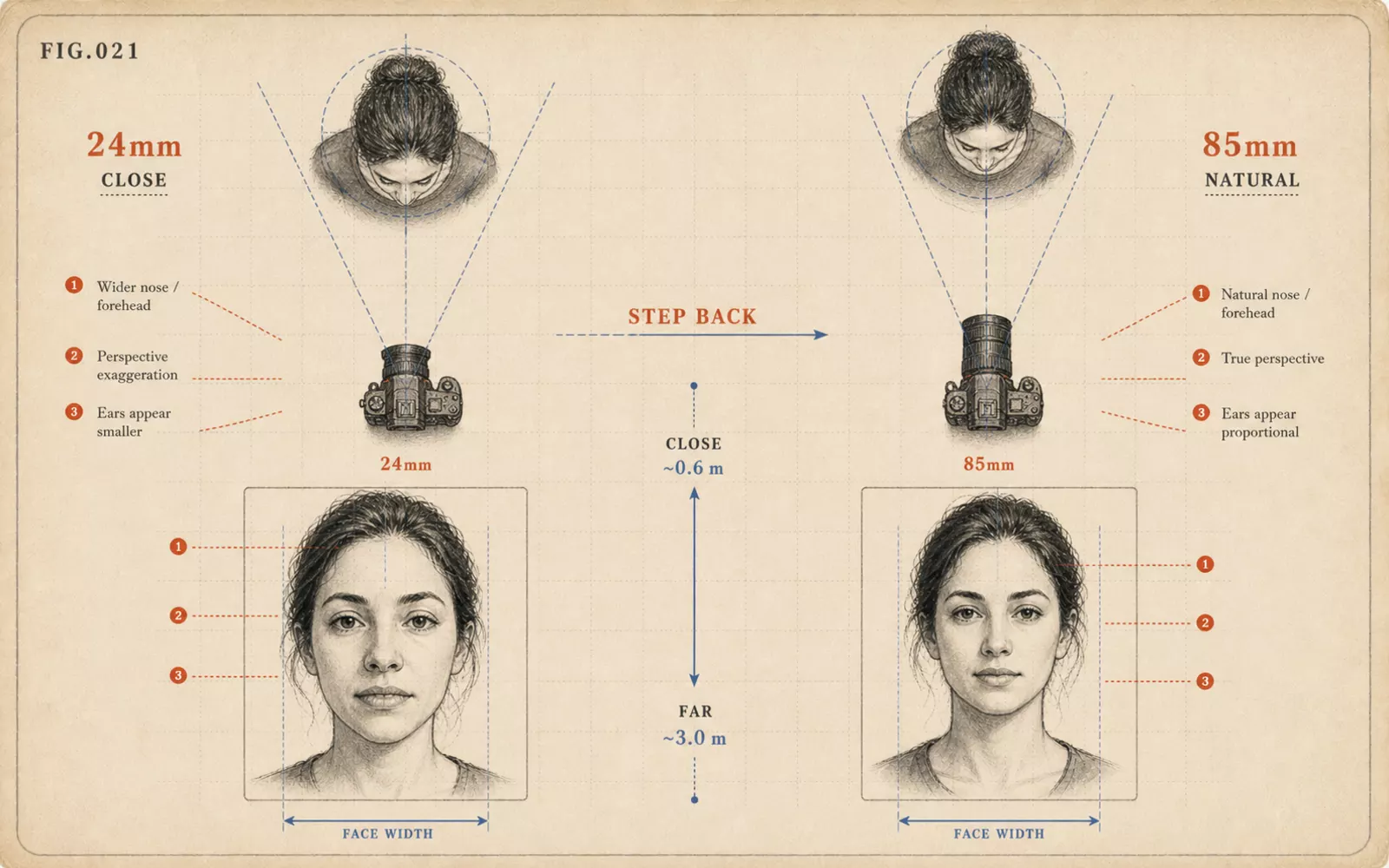 FIG.021The Courage to Ask the Photographer to "Step Back"When the camera is too close, your face appears large and distorted. This diagram covers the idea of using 85–135mm with distance, rather than 24mm up close.
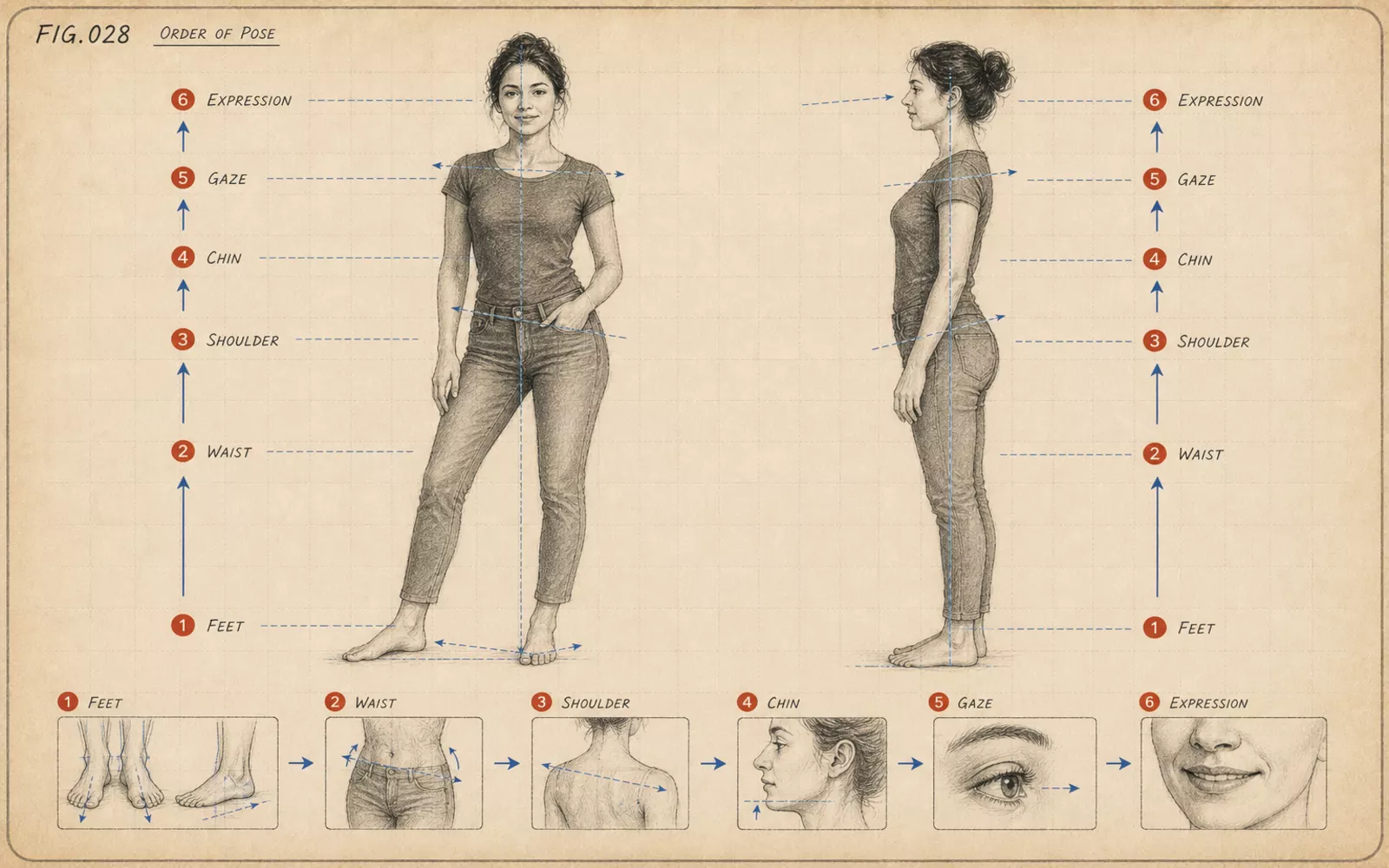 FIG.028The Order to Compose a Pose: Feet → Waist → Shoulders → Chin → Gaze → ExpressionBuild a pose in order: feet, waist, shoulders, chin, gaze, expression. Leaving expression until last prevents facial fatigue.
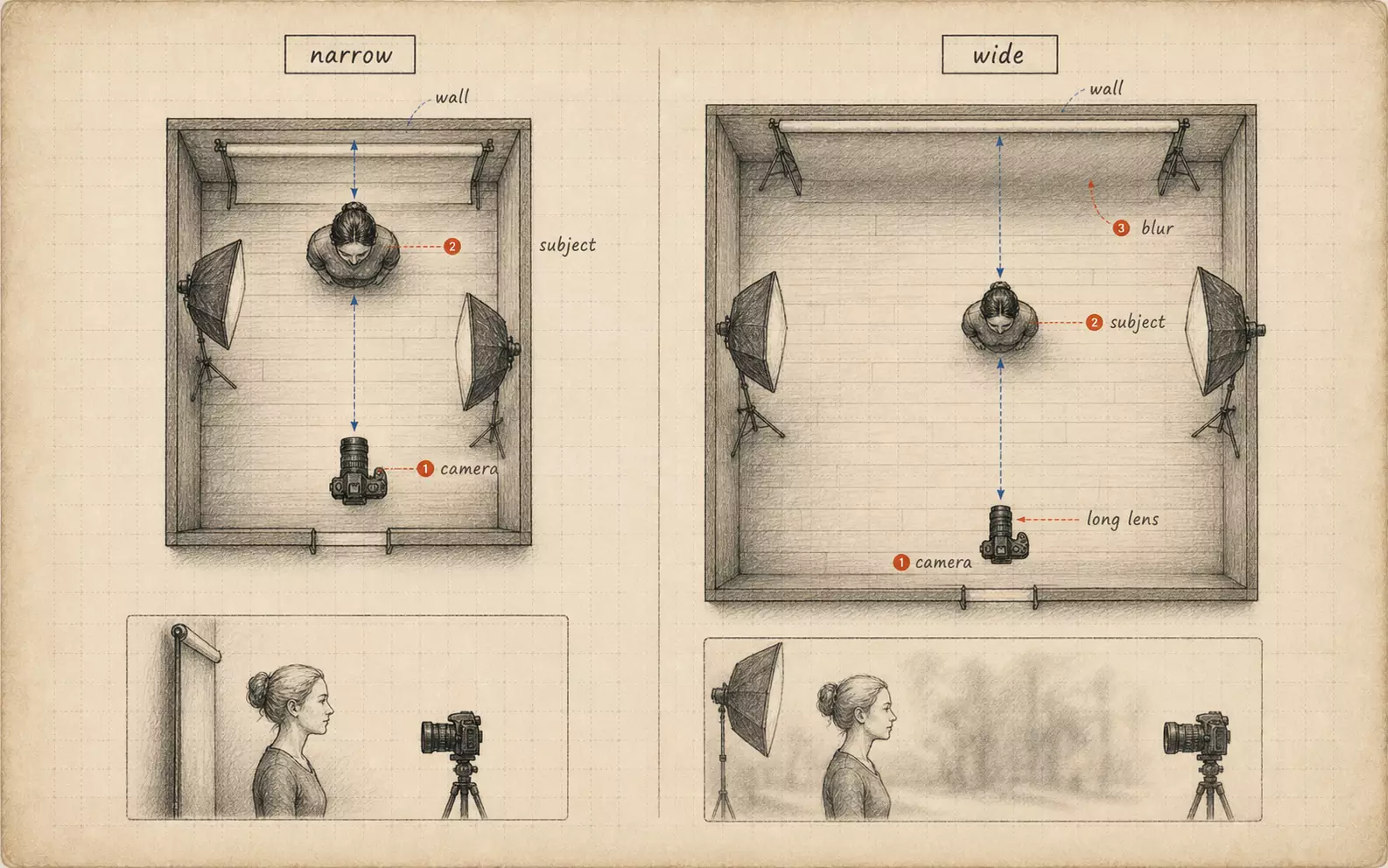 FIG.082How Studio Size Changes What Is PossibleStudio depth is directly linked to lens selection. Shooting full-body at 135mm requires at least approximately 3.88m of retreat distance.